
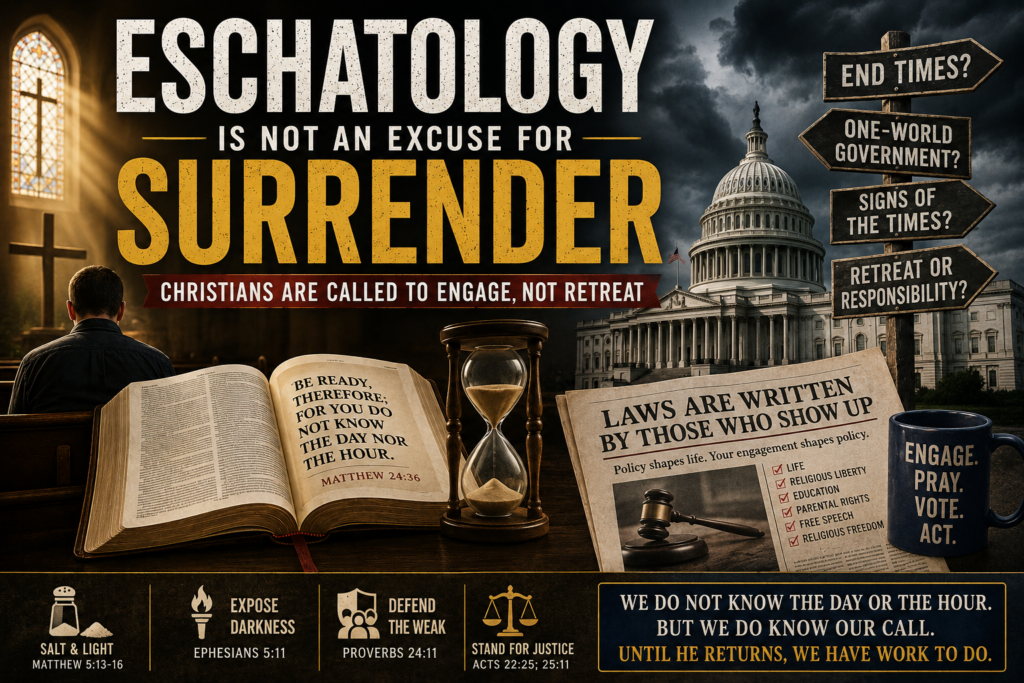
A pastor recently declared that Christians who debate politics or become involved in politics “do not know the Bible.” He then turned to the end times and the coming one-world government.
That pastor is not alone.
Across America, Christians are repeatedly being told, in one form or another: Why concern yourself with politics? Prophecy tells us where this is all going. Christ is returning. A one-world government is coming. Preach the Gospel, pray, worship, love people, and stay out of politics.
Many of these pastors and Christian leaders do encourage their congregations to vote. But casting a ballot every two or four years often seems to mark both the beginning and the end of the political engagement they encourage.
It sounds spiritual. Is it?
But what happens when that theology, in this case, eschatology (End Times), becomes an excuse for surrender?
It may be one of the most dangerous messages being preached to the American Church.
Because while Christians sit in the pews waiting for prophecy to unfold, others are writing the laws under which their children and grandchildren will live.
Many Christian leaders and Christians think of politics as merely candidates, political parties, television arguments, campaigns, and elections. It is all of those things, but it is much more. Those are merely the visible parts.
Politics Is Policy
Politics produces government policy that shapes the lives of citizens. Policy determines whether an unborn baby has the right to live, whether a Christian may operate a business according to conscience, whether parents control their children’s education, what schools teach about sexuality, whether churches may speak freely, how religious organizations are regulated, and whether Christian convictions are treated as legitimate beliefs or unlawful discrimination.
Christian political engagement does not mean making politics our religion, trusting politicians as saviors, or replacing the Gospel with partisan activism. It means refusing to surrender the civil institutions that determine the conditions under which Christians, families, churches, and everyone else live.
What if Christians in every generation before ours had used “the end times are coming” as an excuse for political disengagement and surrender? Would Wilberforce have fought to end slavery? Would Bonhoeffer have resisted the Nazis? Would Christians have stood against Communism, fought for civil rights, defended the unborn, protected religious liberty, or battled for education?
What if the Crusaders, with all their mistakes, had simply refused to fight? Would the Christian-Western civilization they defended have survived and developed into the civilization we inherited, one that gave the West centuries of freedom, individual liberty, human rights, and unmatched prosperity?
In fact, the Bible overwhelmingly points toward involvement and responsibility.
Noah believed God—and built.
Moses trusted God—and confronted Pharaoh.
Joshua trusted God—and crossed the Jordan.
David trusted God—and went toward Goliath.
Esther fasted—and then entered the king’s court at the risk of her life.
Nehemiah prayed—and built the wall with opposition surrounding him.
Paul trusted God—and nevertheless invoked his Roman citizenship and legal rights.
None of them said, God is sovereign; therefore, I shall do nothing.
Scripture teaches Christians engage and not retreat from the world while waiting for Christ’s return; it repeatedly calls us to engage it faithfully. Jesus said, “You are the salt of the earth” and “You are the light of the world,” commanding us, “Let your light so shine before men” (Matthew 5:13–16). Paul tells believers, “Have no fellowship with the unfruitful works of darkness, but rather expose them” (Ephesians 5:11). Proverbs commands, “Deliver those who are drawn toward death, and hold back those stumbling to the slaughter” (Proverbs 24:11).
And when government threatened Paul unjustly, he did not retreat from the public square, he invoked his rights as a Roman citizen (Acts 22:25) and ultimately declared, “I appeal to Caesar” (Acts 25:11). Esther confronted political power, Daniel stood before kings, and Nehemiah prayed, organized, built, and defended.
The biblical pattern is not retreat. It is faithfulness, vigilance, courage, and action.
The problem is not that Christians are too involved in politics. It is that we are not involved enough.
And What About the End Times?
This brings us back to the end times. When did prophecy become permission to disengage?
The certainty of Christ’s return does not relieve us of our responsibilities until He returns. Yet many pastors, Christian leaders, and Christians have become so consumed with identifying the signs of the end that watching and anticipating can become something closer to obsession.
Christ could return tomorrow, or a thousand years from tomorrow.
We do not know.
Scripture certainly teaches Christ’s return and commands Christians to be ready. But Christ explicitly tells us that the timing belongs to God:
“But of that day and hour no one knows…but My Father only.” Matthew 24:36
And immediately before His ascension, Jesus told His disciples:
“It is not for you to know times or seasons which the Father has put in His own authority.” Acts 1:7
Yet throughout history, some Christians have become consumed with predicting the end, sometimes leading people to disengage, sell possessions, withdraw from society, or engage in other extreme behavior.
And Christians have been certain about the timetable before.
Hippolytus of Rome — c. AD 200: The early Christian theologian calculated from biblical chronology that the culmination of history would come around AD 500. The date passed.
William Miller — 1843–1844: The American Baptist preacher concluded from Daniel that Christ’s Second Coming was imminent. His movement ultimately expected October 22, 1844. The date passed, producing what became known as the Great Disappointment.
Pat Robertson — 1982: Robertson warned of an approaching end-times crisis centered on 1982. On The 700 Club in May 1982, he declared, “I guarantee you by the end of the year there is going to be a judgment on the world.” Earlier Robertson material had also anticipated worldwide financial chaos and nuclear war in 1982. The year came and went.
Edgar Whisenant — 1988: The former NASA engineer published 88 Reasons Why the Rapture Will Be in 1988, identifying a September 1988 window for the Rapture. Millions of copies reportedly circulated, including large numbers distributed to pastors. When the prediction failed, Whisenant issued subsequent predictions.
Harold Camping — 1994 and 2011: The Christian radio broadcaster first predicted that the end could occur in September 1994. He later became internationally famous for predicting May 21, 2011, as Judgment Day, followed by the final destruction of the world on October 21. Both dates passed.
Different centuries. Different calculations. Different signs. The same certainty. And every date passed.
Generations of Christians have interpreted the catastrophes, political developments, and technologies of their own age as signs that the end was upon them.
The two World Wars were signs of the end. Nuclear weapons were signs. The return of Israel to its ancestral homeland became, for many, a prophetic clock. The United Nations was associated with the coming one-world government. Then the European Union. Globalization and the emerging “world order.” The microprocessor. Computer chips. The Internet. Cryptocurrency and the prospect of a one-world currency. And now artificial intelligence.
No pastor, theologian, prophecy expert, or anyone else, knows when that day will come. Using the end times to justify political disengagement is not vigilance. It is speculation being used as an excuse for retreat.
Every generation of Christians must live as though Christ could return tomorrow, and work as though their grandchildren will inherit the consequences of what they do today, because it does.
The Enemy Would Love a Church Confined to the Pew
If Christians do not get involved and act, who will?
The enemies of God would love nothing more than a Church that prays, worships, sings, and waits for the end times while surrendering the institutions that shape the civilization around it.
A Church confined to the pew is no threat to those writing the laws, controlling the institutions, educating the children, shaping the culture, and determining the policies under which Christians themselves must live.
Christians should pray.
Christians should worship.
Christians should preach the Gospel.
Christians should love their neighbors.
Christians should vote.
But that cannot be where our responsibility ends.
The biblical response to evil is not retreat. The biblical response to Christ’s return is not slumber. It is watchfulness, faithfulness, vigilance, courage, and action.
We do not know when Christ will return.
Until He returns, we have work to do.