
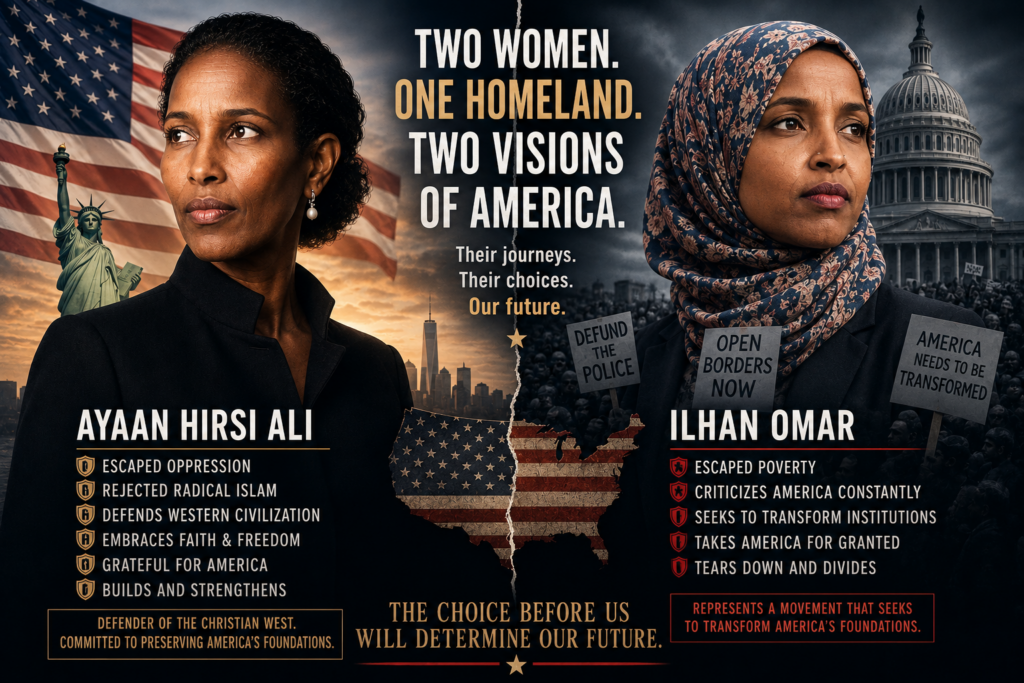
America’s Divide Through the Eyes of Two Somali Women
America is experiencing a cultural and political divide unlike anything seen in modern generations. The gulf between competing visions of the nation continues to widen. Americans increasingly disagree not only on politics and economics, but on fundamental questions involving law enforcement, border security, marriage, sexuality, religion, education, and even the meaning of America itself. The divide has become so deep that many citizens now operate from entirely different understandings of reality.
Few examples illustrate this divide more clearly than the stories of two women born in the same country who ultimately found refuge in the West.
Both fled Somalia.
Both escaped instability and oppression.
Both found freedom and opportunity in Western civilization.
Yet they arrived at radically different conclusions about the nation that welcomed them.
One became a defender of Western civilization.
The other became one of its most vocal critics.
Their names are Ayaan Hirsi Ali and Ilhan Omar.
First Ayaan Hirsi Ali
Born in 1969 in Mogadishu, Ayaan Hirsi Ali grew up in a devout Muslim family. Her father was a political dissident opposed to Somalia’s authoritarian government, causing the family to spend much of her childhood in exile, living in countries including Saudi Arabia, Ethiopia, and Kenya.
During her teenage years in Kenya, she became increasingly committed to Islam, influenced by the growing Islamist movement spreading throughout the Muslim world. Yet she also began questioning aspects of the faith, particularly its treatment of women and the expectation of unquestioning obedience.
In 1992, her family arranged a marriage to a distant cousin living in Canada. Rather than submit, Hirsi Ali fled while traveling through Europe and sought political asylum in the Netherlands. There she learned Dutch, attended university, and eventually became a citizen.
Her intelligence, determination, and willingness to challenge cultural taboos propelled her into Dutch politics. In 2003, she was elected to the Dutch Parliament, where she became an outspoken advocate for women’s rights, immigrant integration, and reform within Muslim communities. She argued that Western societies were often too willing to ignore abuses committed in the name of multiculturalism.
Her international profile exploded after collaborating with filmmaker Theo van Gogh on the short film Submission, which criticized the treatment of women under Islamic law. After the film’s release, van Gogh was murdered by an Islamist extremist, and Hirsi Ali was forced into hiding under constant security protection due to death threats.
For many years, Hirsi Ali rejected religion altogether and became one of the world’s most prominent atheists. She associated with leading figures of the so-called “New Atheist” movement and argued that reason and secularism provided a better foundation for human freedom than religion.
After leaving Dutch politics, she moved to the United States, became an American citizen, and joined organizations such as the American Enterprise Institute and later the Hoover Institution. Through books such as Infidel, Nomad, Heretic, and Prey, she warned Western nations about the dangers of radical Islam, failed assimilation policies, and the erosion of Western values.
In a development that surprised both supporters and critics, Hirsi Ali announced in 2023 that she had become a Christian. She explained that while atheism had helped her reject Islam, it could not provide the moral, cultural, and spiritual foundation necessary to defend Western civilization. She argued that the West faces three major threats: authoritarian powers abroad, Islamist movements, and what she describes as the destructive influence of “woke” ideology at home. Her next book, Why I Am Now a Christian,is planned for publication in 2027.
Today, Hirsi Ali advocate for the preservation of Western civilization, free speech, women’s rights, and the cultural foundations she believes made the West successful. Through her foundation, writings, public speaking, and podcast, she remains one of the most influential voices warning about the dangers of Islamism, uncontrolled migration without assimilation, and the ideological excesses of the modern Left
She is an immigrant who escaped oppression, embraced Western values, experienced both secularism and faith, and now warns that America is repeating many of Europe’s mistakes. Her journey carried her through Islam, secularism, atheism, and ultimately Christianity. That progression gives her credibility with readers because she has experienced each worldview firsthand.
Ilhan Omar
Born in Mogadishu, Somalia, in 1982, Ilhan Omar spent her early childhood during the final years of Somalia’s collapse into civil war. Omar’s father served in the Siad Barre administration, whose regime is widely recognized as an authoritarian dictatorship characterized by political repression, socialist centralization, and serious human-rights abuses. When the Siad Barre regime collapsed, her family fled and lived in a refugee camp in Kenya before being admitted to the United States as refugees in the mid-1990s. They ultimately settled in Minnesota, which would become home to one of the largest Somali communities in America.
Like millions of immigrants before her, Omar arrived in a country that offered opportunities unavailable in her homeland. She received an American education, became a U.S. citizen, and entered public life through community activism and local politics. Within a relatively short period, she advanced from refugee status to the Minnesota Legislature and eventually to the United States Congress, becoming one of the first Muslim women elected to Congress and the first Somali-American to serve in that body.
Yet unlike many immigrants who view America primarily through the lens of gratitude and opportunity, Omar’s political worldview is rooted in her Islamic background while her political activism is firmly aligned with the modern progressive Left. This relationship is often described as an alliance of convenience rather than one of shared values. Traditional Islam and progressive Marxist ideology disagree on many, if not most fundamental moral and social questions. Yet they frequently unite in their criticism of Western civilization, American exceptionalism, national identity, and many of the cultural foundations that have historically defined the West.
Throughout her career, she has focused on themes of systemic racism, economic inequality, identity politics, immigration expansion, and the transformation of American institutions. She has frequently argued that many of America’s systems were built upon injustice and continue to perpetuate inequity.
Perhaps most striking is Omar’s persistent criticism of America itself. Throughout her public career, she has emphasized America’s historical failures regarding race, foreign policy, economic inequality, and social justice. While many immigrants celebrate America as an exceptional nation that provided freedom and opportunity unavailable elsewhere, Omar often portrays the United States as a country whose institutions require fundamental transformation.
This perspective became especially visible in 2025 when she compared contemporary America to authoritarian systems she had experienced in her youth. She stated that the United States was being transformed into “one of the worst countries” and argued that America’s democratic traditions were under assault. Her remarks revealed a profound dissatisfaction with the nation that welcomed her, granted her refuge, and made her remarkable rise from refugee to member of Congress possible.
Omar has become a leading voice of the modern progressive Left, advancing a vision of America that rejects American exceptionalism, questions the nation’s founding ideals, and seeks to fundamentally reshape its cultural and civic identity.
In that sense, her life stands in sharp contrast to that of Ayaan Hirsi Ali. Both women escaped the same troubled region of the world. Both found refuge in the West. Yet one became a defender of Western civilization, while the other became one of its most persistent critics.
So here we have two immigrants from the same country of origin, who found freedom and opportunity in America.
- One expresses gratitude to America; the other is critical of America.
- One is building; the other is tearing down.
- One publicly condemned Radical Islam; the other has not.
- One wants to preserve the Christian West; the other want to tear it down.
- One is grateful for America’s goodness; the other exploits this goodness.
- One sees America’s generosity as a gift; the other treats it as an entitlement.
- One honors the nation that gave her refuge; the other condemns the nation that made her success possible.
- One is a Christian, the other is a Muslim
The stories of Ayaan Hirsi Ali and Ilhan Omar are not merely the stories of two Somali immigrants. They represent two competing visions of America and, ultimately, two competing visions of civilization itself.
One sees America and the Christian West as a rare and extraordinary achievement worthy of preservation. The other sees America primarily through the lens of its failures and believes its institutions require fundamental transformation.
The question before us is not which woman has achieved greater success. Both have achieved remarkable success. The question is which vision of America will prevail.
We have been told that patriotism is dangerous, that national pride is something to be ashamed of, and that America’s history is little more than a chronicle of oppression and injustice. We have watched as our schools, media, corporations, and even many churches have abandoned the principles and traditions that made this nation the most prosperous, free, and powerful civilization in human history.
Ayaan Hirsi Ali understands something many have forgotten. America did not become exceptional by accident. The freedoms we enjoy were not inevitable. They are the product of a civilization built upon biblical morality, individual liberty, personal responsibility, the rule of law, and a culture that rewards hard work, initiative, and self-government.
Those foundations must be defended.
America must once again embrace a confident national identity. We must unapologetically teach our history, celebrate our achievements, honor our heroes, and instill gratitude for the blessings of citizenship. A nation that loses confidence in itself will eventually surrender to those who have no confidence in it at all.
Likewise, America must reject the failed experiment of multiculturalism. The purpose of immigration is not to transform America into a collection of competing cultures and loyalties. The purpose of immigration is to invite newcomers into the American family.
I, an immigrant, unequivocally and unapologetically assert that the Christian-Western-American civilization, rooted in the teachings of Christianity, is superior to any other civilization that has ever existed.
The evidence is clear.
Immigrants should be welcomed. They should be treated with dignity and respect. And they should also be expected to assimilate, integrate, and embrace the values that made America successful. Citizenship must mean more than occupying the same geographic space. It must involve a shared commitment to a common culture, a common language, a common civic identity, and a common future.
The lesson of history is clear. Nations that lose their identity eventually lose their freedom.
The Christian, Western, American civilization has produced more freedom, prosperity, human dignity, scientific advancement, charitable works, and opportunity than any civilization in history. It is not perfect. No human institution is. But compared to every alternative offered by socialism, communism, tribalism, Islamism, or authoritarian rule, its record stands unmatched.
Those who come to America are welcome to bring their food, customs, traditions, and personal experiences. But the values that govern America must remain American values—rooted in the Christian and Western heritage that gave birth to this nation.
The choice before us is simple.
Will America remain America?
Or will it become something else?
The answer will depend on whether we have the courage to defend the civilization we inherited and the determination to pass it intact to the generations that follow.