
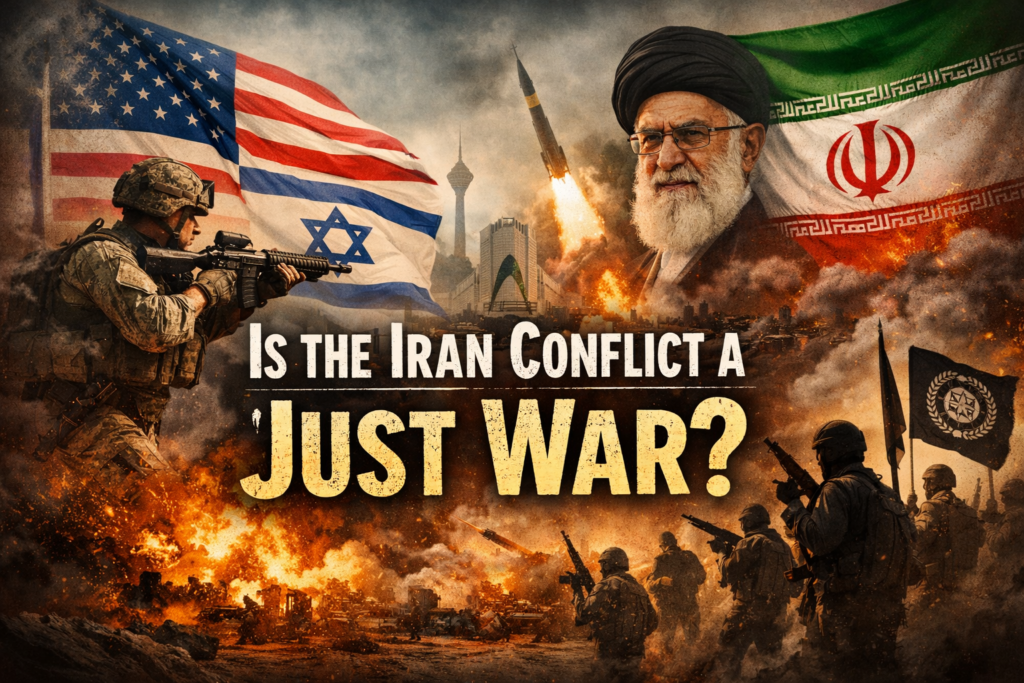
As the American–Israeli operations against Iran continue, the question before us is not only political, it is moral. War is not justified by power, emotion, or national interest alone. It must be judged against a higher standard of truth and justice. If we are to answer this question with clarity and conviction, we must first understand what a “just war” is.
The answer is grounded in Christian moral theology. For centuries, Christian thinkers have wrestled with a difficult question: when, if ever, is the use of force morally justified? From this reflection emerged what is now known as Just War theory, not as a single document or decree, but as a body of moral reasoning developed over time.
Two theologians stand out in shaping this tradition: Augustine of Hippo and Thomas Aquinas. Though separated by nearly eight centuries, both articulated principles that have endured as the core moral criteria for evaluating war.
In the fourth and early fifth centuries, Augustine addressed the tension between the Christian call to peace and the responsibility of governing authorities to restrain evil. He did not present a formal doctrine of “just war” in a single systematic form. Rather, across his writings, especially in The City of God, he argued that war may be morally permissible when it serves justice and the restoration of peace. For Augustine, war is never to be desired; it is a tragic necessity in a fallen world. Yet he also taught that Christians may take up arms out of love for neighbor, when doing so restrains wrongdoing and protects the innocent.
From Augustine’s reasoning, three enduring principles can be clearly identified:
First, Just Cause. War may be morally permissible when it is fought to repel aggression, restore justice, or address grave wrongdoing, not for conquest, glory, or revenge.
Second, Legitimate Authority. The decision to wage war belongs to lawful governing authorities responsible for the common good. Private individuals or factions have no such right.
Third, Right Intention. Even when a war is justified, its purpose must be the restoration of peace and justice, not hatred, cruelty, or vengeance.
Centuries later, Aquinas presented these same principles explicitly in his theological work Summa Theologica. In doing so, he did not introduce a new theory, but clarified and concisely expressed what had already been developed within the Christian moral tradition. He identified legitimate authority, just cause, and right intention as the essential conditions for a just war, giving the tradition a clear and enduring formulation.
In later centuries, Christian thinkers expanded this framework with additional considerations:
last resort, meaning war should be undertaken only after serious diplomatic efforts have failed; probability of success, meaning the war must have a realistic chance of achieving its objective without needless loss of life;
proportionality, meaning the harm caused must not exceed the injustice being addressed; and civilian protection, requiring that noncombatants not be deliberately targeted.
Together, these principles form the moral framework Christians have used for centuries to evaluate whether a war is just—or unjust.
With this framework in mind, the central question becomes clear: does the current conflict with the Islamic Republic of Iran meet these criteria?
To answer that question, we must examine the evidence of the past five decades.
- Oppression of the Iranian people
Since the 1979 Iranian Revolution, Iran has been governed by a rigid Islamic totalitarian regime. This theocratic regime concentrates political and religious authority in the office of the Supreme Leader and the clerical establishment.
The regime’s treatment of its own citizens has been marked by systemic repression. Political dissent is suppressed, journalists and activists are imprisoned, and opposition movements are often crushed through intimidation or violence.
Women in particular have been subjected highly restrictive laws and brutal enforcement, treating defiance of its gender rules, especially mandatory hijab, as a direct threat. Women and girls, starting around age 7–9, must cover their hair and body in public under penalty of arrest, beating, fines, imprisonment, or worse, enforced by the “morality police” and surveillance tools. The regime introduced the “Hijab and Chastity Law” and “Noor Plan,” using facial-recognition cameras, automated text warnings, fines, vehicle confiscation, travel bans, job loss, and possible death penalty for repeat offenses.
In the 2025–2026 crackdown, two nurses who treated wounded protesters in a Tehran hospital were arrested, tortured, and repeatedly gang-raped by agents. Similar patterns (rape, threats of rape, and sexual assault) were documented in 2022 and repeated in 2026. Reports emerged of women’s bodies being returned to families with organs (including wombs) removed to conceal evidence of sexual crimes before or after killing. Amnesty International and the UN Fact-Finding Mission have described this as part of a broader pattern, amounting to crimes against humanity.
September 13, 2022, Mahsa Amini, visiting Tehran from Saqqez in Kurdistan province with her brother, was arrested by Iran’s morality police near the Shahid Haghani Expressway after exiting a metro station. The reason: “improper hijab”, authorities claimed some of her hair was visible under her headscarf. She was not wearing anything unusually provocative; many witnesses described her attire as standard. Police told the family she would be taken to the Vozara Detention Center for a short “re-education” or “guidance” class on hijab rules and released within an hour. Multiple eyewitnesses (including other detained women) reported that Amini was beaten inside the police van shortly after arrest. They described slaps, punches, and blows to the head and body.
At the detention center, she began feeling ill, lost vision, collapsed, and fell into a coma within about 26–45 minutes of arrival. CCTV footage released by authorities (edited and segmented) shows her suddenly collapsing while speaking to a female officer. Critics note delays in calling for medical help and reports of officers mocking her. Mahsa Amini died in the hospital, three days after her arrest. She was 22 years old.
This incident was a tragic but representative example of the systematic, state-enforced treatment of women in the Islamic Republic of Iran, rooted in laws that treat women as second-class citizens and enforce strict gender segregation and dress codes. The regime has used compulsory hijab as a tool of control since 1979, with the morality police acting as one visible arm of that system.
The Iranian regime has killed its own citizens during demonstrations against the government in recent months, particularly during the widespread protests that escalated in late December 2025 and peaked in January 2026. These protests, driven by economic crises, inflation, unemployment, and calls for regime change, faced a severe crackdown by security forces, including the use of live ammunition, resulting in mass casualties. Estimates vary widely based on sources, with human rights organizations reporting up to 36,500 people killed while official Iranian statements reported a much lower number.
The Islamic Republic of Iran systematically persecutes Christians, particularly converts from Islam, who attend house churches, while imposing severe restrictions on recognized historic Christian communities. The regime views evangelical Christianity and conversion from Islam as threats to its Islamic identity and national security, often linking them to “Western/Zionist influence.” Although Article 13 of the constitution nominally protects recognized religious minorities, in practice Christians face discrimination in law and daily life, and converts risk charges carrying prison terms, exile, or death for apostasy or “enmity against Allah”. Proselytizing, Persian-language worship, and house-church activities are treated as crimes.
Security forces, often the Ministry of Intelligence or IRGC, routinely raid house churches, seize Bibles and religious materials, and detain attendees. Interrogations frequently involve psychological and physical abuse, threats to family members, and pressure to recant faith or inform on others. Charges are almost always framed as national-security offenses “propaganda against the state,” “acting against national security,” or “deviant propaganda contrary to Islam” under Article 500 of the Penal Code, amended to carry up to 10 years. Sentences have grown harsher. Prisoners face denial of medical care, solitary confinement, and torture. High bail amounts, often millions of dollars, financially devastate families.
Taken together, the regime’s systemic oppression of women, the violent suppression and killing of dissenters and protestors, and the ongoing persecution of Christians reveal a government that stands in direct opposition to justice and human dignity. By any serious moral standard, particularly one rooted in Christian theology, the Iranian regime is not merely flawed but profoundly unjust. A government that consistently terrorizes its own people forfeits its moral legitimacy. For the sake of the Iranian people, and in defense of fundamental human dignity, such a regime must ultimately be confronted, defeated, and replaced with one that upholds justice, protects the innocent, and allows its people to live in freedom.
- Global Sponsor of Terrorism
Beyond its internal oppression, the Iranian regime has played a major role in sponsoring militant groups across the Middle East and beyond.
Organizations such as Hezbollah, Hamas, and numerous militia networks operating in Iraq, Lebanon and Syria have received support from elements of the Iranian state, particularly the Islamic Revolutionary Guard Corps and its external operations branch, the Quds Force.
Through these proxies, the regime has extended its influence through violence, destabilizing neighboring countries and contributing to decades of regional conflict. These networks have targeted civilians, launched rocket attacks, and threatened democratic allies in the region.
The Iranian regime’s role in global terrorism is not abstract; it has manifested in some of the most consequential acts of violence in recent years. The October 7 attack on Israel carried out by Hamas did not occur in isolation. Hamas has long been supported, funded, and armed by Iran. Statements attributed to Hamas leadership, including remarks from the late leader Yahya Sinwar, have acknowledged the depth of Iranian backing in enabling Hamas’ military capabilities. This sustained relationship underscores a critical reality: the regime in Tehran does not merely sympathize with such attacks; it has materially contributed to building the infrastructure that makes them possible.
- Hatred and Animosity Toward the United States
The adversarial relationship between Iran and the United States has existed since the Iran hostage crisis, when American diplomats were held hostage for 444 days. Since then, Iranian-backed militias have been implicated in attacks on American personnel in the Middle East, and Iranian leaders have repeatedly characterized the United States as a central enemy of the regime.
The Iranian regime’s hostility toward the United States is not limited to rhetoric; it has been demonstrated through decades of direct and indirect aggression. One of the earliest and most devastating examples was the 1983 bombing of the U.S. Marine barracks in Beirut, carried out by operatives linked to Hezbollah, a group created, funded, and directed by Iran. In Iraq and Afghanistan, Iranian-backed militias have been responsible for the deaths of American service members through the use of advanced roadside bombs and coordinated attacks. The regime has also been implicated in numerous plots and operations targeting U.S. interests and personnel across the region. Taken together, the pattern is unmistakable: a sustained campaign of hostility, executed both directly and through aligned militant organizations, aimed at undermining American presence and influence in the Middle East.
The Iranian regime’s hostility toward the United States has been sustained for over four decades. Since the early years following the Iranian Revolution, Iranian leaders have repeatedly referred to the United States as the “Great Satan,” a term popularized by Ruhollah Khomeini. This rhetoric has not remained confined to speeches; it has been echoed in state-sponsored demonstrations where chants of “Death to America” and burning of the American flag, have been a recurring feature. Such language reflects not merely political disagreement but an entrenched ideological hostility. The pattern is clear and consistent, decades of declared enmity supported by concrete acts of aggression.
In May 2018, members of Iran’s parliament, publicly burned a representation of the American flag (which also had “Death to America” written on it) and a copy of the nuclear agreement while chanting “Death to America.”
- The Nuclear Threat: Clear and Present Danger
The Iranian regime’s pursuit of nuclear capability represents not a distant or theoretical concern, but a real and present danger, not only to the United States and Israel, but to the stability of the world. For years, Iranian officials have insisted that their nuclear program is intended for peaceful purposes, such as energy production. However, this claim is difficult to reconcile with the regime’s actual enrichment activities and repeated lack of transparency.
Civilian nuclear energy programs typically require uranium enrichment levels of 3–5%, and in some limited cases up to 20% for research reactors. By contrast, Iran has accumulated hundreds of pounds of uranium enriched to approximately 60% purity, a level far beyond any legitimate civilian requirement and alarmingly close to weapons-grade material.
Weapons-grade uranium is generally defined as 90% enrichment, and nuclear experts widely agree that once enrichment reaches 60%, the remaining step to weapons-grade can be achieved in a relatively short timeframe, potentially within weeks.
Estimates from international monitoring bodies have indicated that Iran has amassed enough highly enriched uranium that, if further refined, could be sufficient for multiple nuclear weapons, often cited in the range of 10 or more devices. This is not speculative capacity; it is a threshold capability that places the regime on the edge of becoming a nuclear-armed power.
Compounding this threat is Iran’s parallel development of advanced missile systems. The regime has invested heavily in long-range and increasingly sophisticated ballistic and hypersonic deliveryplatforms, designed to carry significant payloads across vast distances. These systems are capable of reaching targets throughout the Middle East and Europe, and potentially beyond.
These capabilities cannot be viewed in isolation from the regime’s longstanding rhetoric. Iranian leaders have repeatedly issued threats against both Israel and the United States. When such declarations are combined with near-weapons-grade nuclear material and advanced delivery systems, the risk is no longer theoretical, it becomes immediate and strategic.
- Apocalyptic Ideology and the Question of Intent
An additional factor that cannot be ignored is the fanatic ideological framework held by elements within the Iranian regime, particularly those influenced by Twelver Shi’a theology.
Within Twelver Shi’a Islam, there is a belief in the eventual return of the Muhammad al-Mahdi, often referred to as the “Hidden Imam.” According to this belief, the Mahdi, who is understood to have gone into occultation as a child in the 9th century, will return at the end of history to establish justice and rule.
Some interpretations within this tradition hold that his return will be preceded by a period of profound global turmoil, conflict, and upheaval. While many Shi’a scholars emphasize patience and do not advocate attempting to hasten these events, there have been elements within Iran’s revolutionary ideology, particularly among hardline factions, that speak in terms suggesting that chaos and confrontation may play a role in preparing the way for this anticipated return.
This matters because ideology shapes action. A regime that frames history in apocalyptic terms, and that views large-scale conflict as part of a divine trajectory, may calculate risk differently than a purely rational secular government. The willingness to embrace escalation, martyrdom, or widespread destruction can be influenced by such beliefs, especially when combined with political power and advanced military capabilities.
When the five points above measured against the enduring principles articulated by Augustine of Hippo and Thomas Aquinas, the conclusion is clear: this conflict meets the moral criteria of a just war.
The oppression of the Iranian people alone presents a compelling just cause. For more than four decades, the Islamic regime has subjected millions to systemic repression, denying basic freedoms, persecuting women, imprisoning dissenters, and targeting religious minorities. A government that rules through fear, violence, and coercion forfeits its moral legitimacy. The liberation of a people held under such conditions is not aggression; it is a moral imperative consistent with the duty to defend human dignity.
Beyond its borders, the regime has exported instability throughout the region—arming militant groups, fueling conflict, and undermining neighboring nations. This pattern of aggression has not been incidental; it has been deliberate, sustained, and strategic.
At the same time, the regime has maintained a posture of open hostility toward the United States and its allies, issuing constant threats, enabling attacks, and embedding anti-American animosity into its political and ideological identity. The question must be asked plainly: must a nation wait to be struck before it is permitted to defend itself? Just War doctrine has never required such passivity. The responsibility of government is not merely to respond to attack, but to prevent it when the danger is clear and imminent.
That danger is now amplified by the regime’s pursuit of nuclear capability. A hostile theocratic regime, driven by ideological conviction and supported by advanced weapons systems, approaching nuclear threshold status presents a risk that cannot be ignored. The potential combination of fanaticism, destructive capability, and declared hostility creates a scenario in which inaction would be far more dangerous than decisive intervention.
Just War doctrine does not celebrate war. It recognizes war as a tragic necessity in a fallen world. But it also affirms that failing to confront grave and growing evil is itself a moral failure.
In this light, the current conflict is not one of conquest or ambition. It is a war grounded in just cause, undertaken with the aim of restraining evil, restoring stability, and protecting both the innocent and the future of a region, and a world.