
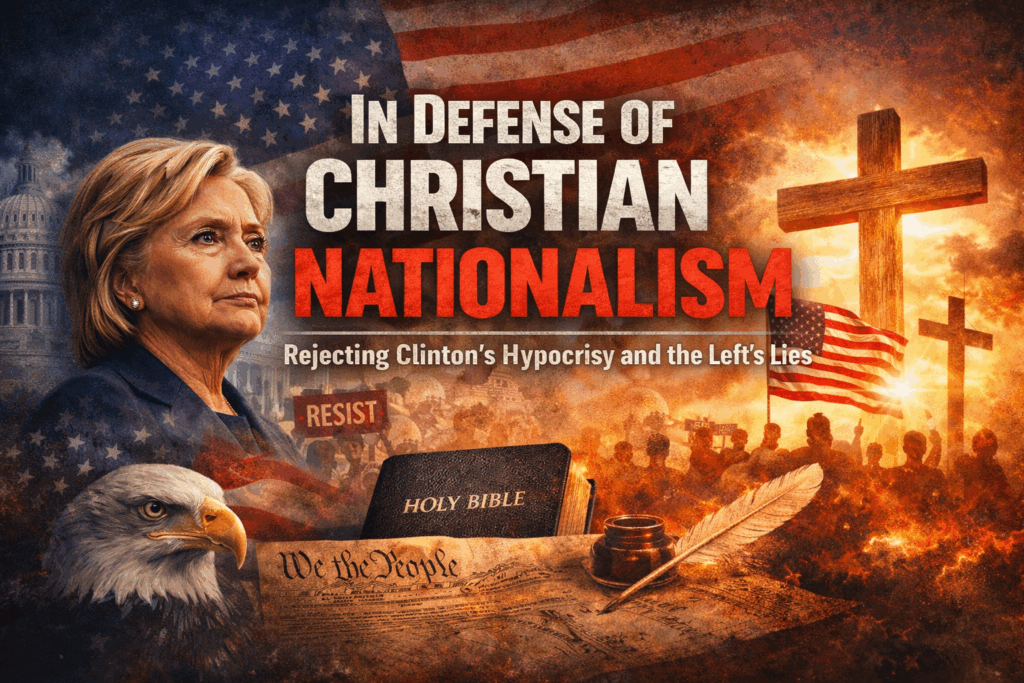
Hillary Clinton is at it again. The same Hillary who coined “the deplorables,” warned of a “vast right-wing conspiracy,” flirted with “reprogramming conservatives”, and routinely casts conservatives as extremists, cultists, or latent terrorists, comes yet another sermon of contempt. This time, Hillary Clinton accuses millions of Americans on the Right of “waging a war on empathy” in a self-righteous op-ed published in The Atlantic, while once again reviving her familiar obsession with demonizing “Christian nationalism.” In Clinton’s telling, faithful Christians who refuse to privatize their convictions are no longer citizens participating in self-government, they are moral threats to be opposed, corrected, and marginalized. It is a familiar pattern: a political class that long ago forfeited humility now weaponizes empathy as a cudgel, demanding submission in the name of compassion while reserving none for those it despises.
She describes Christian nationalism as the belief that God has called certain Christians to dominate every aspect of American life and erase the separation of church and state. This ideology, she warns, is gaining influence in Washington under Trump’s leadership. She uses the Good Samaritan story to argue that genuine Christian faith calls for empathy and kindness to strangers, not exclusion or cruelty, which she says has been abandoned by some MAGA-aligned religious influencers.
Clinton contends that some proponents of MAGA have embraced a version of Christianity that exalts power, vindictive politics, and exclusion over mercy and love for all neighbors, contrary to core biblical teachings. She says this has created a climate where compassion is dismissed as weakness. She urges Christians of all kinds to resist what she calls extremist uses of religion that seek to divide society, and instead to reclaim a vision of faith that unites rather than weaponizes.
I. The Hypocrisy of Hillary Clinton
This article will examine three things: first, the staggering hypocrisy of Hillary Clinton; second, how the Left defines and weaponizes the term “Christian nationalism”; and finally, what Christian nationalism actually is, and why I proudly identify with it.
Clinton’s Atlantic op-ed opens with moral grandstanding, declaring that “this crisis in Minneapolis reveals a deep moral rot at the heart of Trump’s movement.” In her telling, enforcement of immigration law is not governance but wickedness, evidence of a supposed abandonment of the biblical command to love one’s neighbor. The accusation would be laughable if it were not so brazenly dishonest. What the Trump administration is doing, what Clinton condemns as cruelty, is enforcing the law of the land, duly passed by elected members of Congress. The very same laws under which her husband deported millions of illegal aliens during his eight years in office. The same laws her boss Obama used to deported millions more while she served as Secretary of State. One is left to wonder: where was this newly discovered empathy then? Was it dormant during those decades, or merely politically inconvenient?
Clinton’s hypocrisy deepens when she cloaks her political attack in religious language. In promoting her essay on X, she wrote that “Christians like me, and people of faith more generally, have a responsibility to stand up to” what she labels religious extremism. This is rich coming from a figure whose political career has been defined by open hostility to the very institutions God Himself established: marriage, the family, and the sanctity of human life. Faithful Christians do not need lectures on moral responsibility from those who advance, defend, and normalize policies that are explicitly antibiblical. If there is a revolt needed, it is not against Christianity’s public witness, but against politicians who invoke the language of faith while waging war on its substance.
Clinton further props up her argument by citing warnings from “major ecumenical bodies” such as the National Council of Churches, claiming that Christian nationalism distorts Scripture and undermines Christian humility. That she would invoke the NCC is hardly surprising. The organization is steeped in progressive theology, committed to the social gospel, supportive of same-sex marriage and LGBTQ clergy, doctrinally hollow, and consistently hostile to evangelical Christianity. It is far more aligned with secular progressivism than with biblical orthodoxy. To cite the NCC as an authority on Christian faith is not evidence of humility, it is evidence of ideological convenience.
Finally, Clinton claims that the Trump administration’s so-called “war on empathy” “threatens to pave the way for an extreme vision of Christian nationalism that seeks to replace democracy with theocracy in America.” This is a familiar and reckless charge. Christian nationalism does not threaten democracy. What it threatens is the progressive Left’s monopoly on moral authority, its failed policies, its wavering ethics, and its persistent ignorance of Scripture and history. The real fear is not theocracy, it is the reassertion of a moral framework that places limits on the state and accountability above it.
This is not a warning. It is an accusation meant to intimidate, marginalize, and silence Christians who refuse to surrender their convictions at the altar of progressive politics.
II. How the Left Defines “Christian Nationalism”
Before Christian nationalism can be condemned, it must first be caricatured. The Left’s strategy is consistent across academia, media, activism, and government: define the term so narrowly, so maliciously, and so dishonestly that no faithful Christian could possibly recognize himself in it, then condemn the invention as a moral emergency.
In leftist academia, Christian nationalism is defined as the belief that the United States is fundamentally a Christian nation and therefore should be governed according to Christian values, symbols, and moral authority, often privileging Christianity in law and public life. This definition is presented as neutral scholarship, yet it is loaded with ideological assumptions. It treats Christianity’s moral influence as illegitimate by default, as if moral frameworks derived from Christianity are inherently oppressive while secular moral frameworks are somehow neutral, rational, and benign. Academia’s real objection is not to “privilege,” but to Christianity itself exercising any influence beyond the private conscience.
In mainstream media, the definition becomes more overtly hostile. Christian nationalism is framed as a political ideology that fuses conservative Christianity with American identity in ways that allegedly undermine pluralism, the separation of church and state, and democratic norms. This framing rests on a false premise: that democracy can exist without a moral foundation, and that pluralism requires the exclusion of Christianity from public life. The media does not object to moral influence in politics, it objects to Christian moral influence. Progressive ideology is allowed to saturate law, education, and culture without controversy; Christianity is labeled dangerous the moment it refuses silence.
Among progressive activists, the rhetoric escalates into outright accusation. Christian nationalism is described as an extremist ideology seeking to impose a narrow, coercive version of Christianity on government, law, and culture, supposedly at the expense of women, LGBTQ individuals, immigrants, and religious minorities. This is not analysis; it is propaganda. The claim assumes that biblical morality is inherently cruel, that Christian conviction is indistinguishable from coercion, and that any moral boundary enforced by law is an act of hatred. By this logic, laws against murder, theft, or exploitation are acceptable only if stripped of their Christian origin and rebranded in secular language.
Finally, within government and quasi-governmental circles, Christian nationalism is vaguely described as a movement where religious identity is used to justify exclusionary or anti-democratic political behavior. Notice the ambiguity. No clear definition is offered, no limiting principle applied. Peaceful civic engagement by Christians, voting according to biblical conscience, or advocating laws rooted in Christian moral reasoning can all be swept into this category at will. The term becomes a political weapon flexible enough to criminalize dissent and stigmatize belief.
None of these definitions withstand serious scrutiny. None reflects historical reality. None accurately describes what Christian nationalists actually believe or advocate. Instead, they reveal a deeper truth: the Left does not fear Christian nationalism because it is violent, authoritarian, or anti-democratic. The Left fears it because Christianity insists on moral limits, limits on government power, limits on human desire, and limits on ideological ambition.
Christian nationalism is not condemned because it is false. It is condemned because it refuses to bow.
III. What Christian Nationalism Actually Is
Christian nationalism is the conviction that a nation’s laws, culture, and moral framework are healthiest when they openly acknowledge God, draw from Christian moral truth, and recognize that rights do not originate with the state but from a higher authority. It rejects the modern fiction that government is the source of rights and affirms instead the biblical and Western understanding that the state is accountable to moral law, not sovereign over it.
Christian nationalism further affirms that Christians are not merely permitted, but biblically mandated to engage in the political process. Scripture does not command believers to retreat into private faith or civic silence. It commands moral witness, righteous governance, and resistance to evil. Accordingly, Christian nationalists reject the demand that believers step aside, self-censor, or withdraw from public life to appease those who openly despise Christianity and seek its removal from the nation’s moral vocabulary.
Christian nationalism also recognizes historical reality. The United States was founded on Christian principles and values, not on religious neutrality, not on moral relativism, and not on the ethical frameworks of any other religion or civilization. The nation’s concepts of liberty, justice, human dignity, and limited government emerged directly from the Christian worldview that shaped the West. To deny this is not humility; it is historical falsification.
For this reason, Christian nationalists unapologetically assert the primacy of Christian Western civilization, the civilization that produced ordered liberty, constitutional government, the rule of law, and the moral architecture necessary for freedom to endure. This assertion is neither racial nor coercive; it is civilizational and factual. Confidence in one’s inheritance is not extremism, it is responsibility.
Nor do Christian nationalists accept the Left’s glaring double standard. Nations such as Saudi Arabia openly declare themselves Islamic states, structure their laws accordingly, and face little condemnation from Western elites. Yet when Christians assert that America’s identity, laws, and culture are rooted in Christianity, the same elites erupt in accusations of extremism and theocracy. This is not a principled objection to religious nationalism, it is selective outrage aimed at Christianity alone.
Above all, Christian nationalism insists on a fundamental truth: a people who are taught to despise, deny, or forget their Christian heritage will not long retain their freedom, their culture, or their nation. Civilizations do not survive on shame, relativism, or moral amnesia. They endure only when they know who they are, where they came from, and what they are willing to defend.
Christian Nationalism is not a threat to America. It is the last defense of it.
Why I Am a Proud Christian Nationalist
Hillary Clinton’s Atlantic op-ed is not a warning, it is a projection. It is the moral posturing of a political figure. Her sudden discovery of “empathy,” her selective invocation of Scripture, and her self-appointment as an arbiter of Christian faith would be amusing if the consequences were not so serious. Clinton condemns Christians who seek to shape public life while excusing, indeed celebrating, the aggressive imposition of secular progressive ideology through law, education, and culture. That is not empathy. It is hypocrisy wrapped in sanctimony.
The broader Left’s assault on “Christian nationalism” follows the same dishonest pattern. The term has been deliberately redefined, distorted, and weaponized to smear faithful Christians as extremists, authoritarians, or enemies of democracy. In reality, what the Left fears is not theocracy, it is accountability. It fears a moral framework it does not control, a source of authority higher than the state, and a people unwilling to surrender their convictions for social approval or political safety. “Christian nationalism” has become the accusation hurled at Christians who refuse to be silent, invisible, or ashamed.
I reject that lie entirely.
I am a Christian nationalist because I believe truth exists, morality is real, and nations are not self-creating. I believe rights come from God, not government. I believe Christians are commanded to engage the world, not flee from it. I believe America’s freedoms were born from Christian soil and cannot survive long once that soil is scorched by relativism and contempt. I believe Western civilization, formed by Christianity, is worth defending, not apologizing for.
And I am proud of it.
Pride in one’s Christian heritage is not hatred. Moral conviction is not extremism. Public faith is not tyranny. What truly threatens democracy is a ruling class that demands submission without belief, obedience without truth, and silence in the face of lies. Christian nationalism stands against that, not with force, but with faith, history, and courage.
The Left may sneer. Hillary Clinton may scold.
I will not retreat. I am a Christian nationalist, and I am done apologizing.