
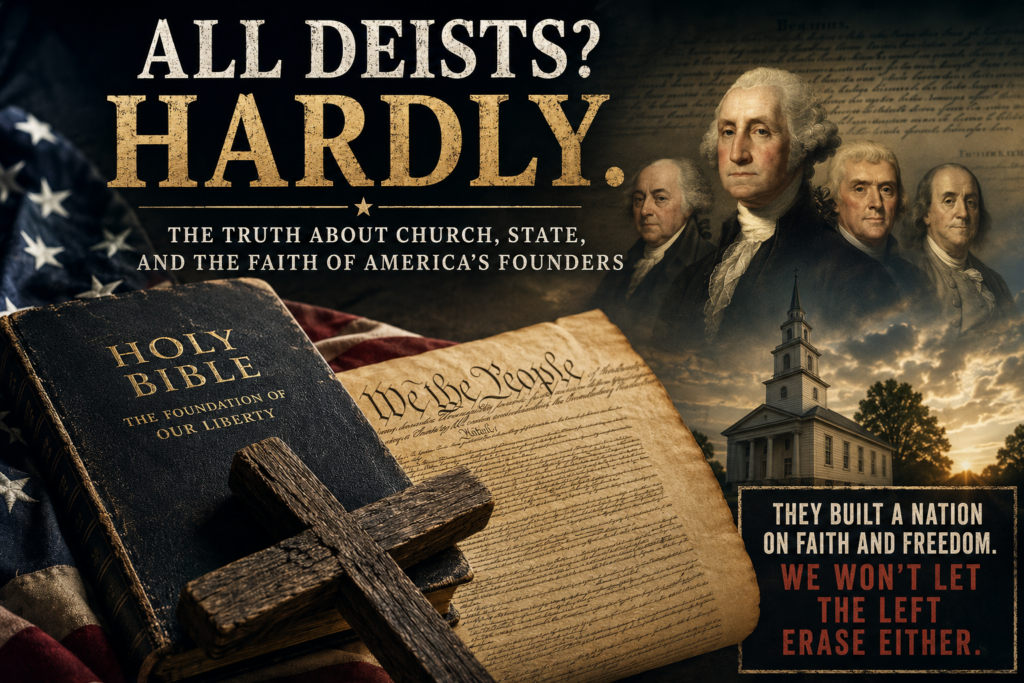
All Deists? Hardly.
At a recent New Hanover County School Board meeting, a speaker declared with confidence that “all the Founding Fathers were deists, except for John Adams, a unitarian, who later became a deist”, and invoking the now ritualized phrase “separation of Church and State”. Some Founders did hold unorthodox or deistic views. But the sweeping claim that all the Founders were deists is historically false, and the modern weaponization of Jefferson’s phrase is a distortion of its original purpose.
These are not harmless errors. They are modern myths, built on selective quotation, historical amnesia, and a fundamental misreading of the Founders’ own words. Promoted and endlessly repeated by the progressive Left, this narrative, while not just merely wrong, it is useful propaganda. And that is precisely why it persists. When the record is examined honestly and in full, that narrative collapses. What remains is not ambiguity, but clarity.
I. What “Separation of Church and State” Actually Means
The phrase appears nowhere in the Constitution or the Bill of Rights. It originates from a private letter written by Thomas Jefferson on January 1, 1802, to the Danbury Baptist Association, evangelical Christians concerned that government interference might threaten their religious liberty. They were not asking for secularism. They were asking for protection.
Jefferson responded with reassurance:
“Believing with you that religion is a matter which lies solely between Man & his God… I contemplate with sovereign reverence that act of the whole American people which declared that their legislature should ‘make no law respecting an establishment of religion, or prohibiting the free exercise thereof,’ thus building a wall of separation between Church & State.” [i]
This “wall” was not a barrier to faith, it was a barrier against government intrusion.
It runs in both directions:
- It prevents the state from controlling the church
- It prevents the state from suppressing religious expression
Jefferson’s letter was a shield for religion not a weapon against it.
And yet today, that letter, written to protect faith from government intrusion, has been turned precisely on its head. Activist organizations, school administrators, and their allies on the progressive Left now invoke “separation of Church and State” not to shield religious conscience, but to drive visible expressions of faith out of the public square.
If you believe this is merely academic rhetoric, think again. It is not theory, it is reality. The principle once intended as a safeguard has been weaponized. And its application is anything but neutral.
Time and again, this weaponization falls with precision on one target: Christianity. The standard is not consistent. It is selective.
Consider the following three cases.
- In 2015, high school coach Joe Kennedy was punished for a brief, silent, post-game prayer. After years of litigation, the Supreme Court in Kennedy v. Bremerton School District (2022) ruled in his favor, affirming that the Constitution forbids government hostility toward personal religious expression.[ii]
- In 2024, Marisol Arroyo-Castro, a veteran teacher in Connecticut, was ordered to remove a small crucifix from her desk or face discipline. She refused—and was removed from the classroom. A federal lawsuit followed.[iii]
- In 2017, a Florida ninth-grade student was told to remove a cross necklace because it was labeled a “gang symbol.” No policy. No precedent. Just raw hostility cloaked in legal language.[iv]
These are not isolated incidents. They are symptoms of a broader inversion used by the progressive Left, where the First Amendment is no longer protecting religious expression, but policing it.
This distortion was not accidental. Beginning with Everson v. Board of Education (1947), the Supreme Court of the United States stretched and misapplied Jefferson’s metaphor, converting a shield for religious liberty into a tool for its restriction. In doing so, it helped unleash the chaotic interpretations now embraced by the progressive Left.
II. The Founders Were Not Deists — In Their Own Words
Deism asserts that God created the universe and then withdrew, a distant architect who neither hears prayer nor intervenes in human affairs.
To claim that all the Founders were deists is to claim they believed in precisely such a God. Their own words make that claim impossible to sustain. These quotations are illustrative, not exhaustive. The full version of this article, over 4,700 words, includes many more statements from these and other Founders. What is presented here is a condensed selection for broader readability.
George Washington wrote:
“Religion and morality are indispensable supports… let us with caution indulge the supposition that morality can be maintained without religion.”[v]
“You do well to wish to learn our arts and ways of life, and above all, the religion of Jesus Christ; these will make you a greater and happier people than you are.”[vi]
In his Thanksgiving Proclamation of 1789, issued at the request of Congress, Washington called upon the nation to acknowledge “the providence of Almighty God, to obey His will, to be grateful for His benefits, and humbly to implore His protection and favor.” A deist does not call a nation to prayer. A deist does not believe prayer reaches anyone.
John Adams stated bluntly:
“I have never known an irreligious man who was not a rascal.”[vii]
“The general principles on which the Fathers achieved independence were the general principles of Christianity.”[viii]
John Quincy Adams declared:
“The American Revolution… connected the principles of civil government with the precepts of Christianity.”[ix]
My hopes of a future life are all founded upon the Gospel of Christ.[x]
“No book in the world deserves to be so unceasingly studied, and so profoundly meditated upon as the Bible.[xi]
Samuel Adams:
“I, Samuel Adams… recommend my soul to that Almighty Being who gave it, and my body I commit to the dust, relying upon the merits of Jesus Christ for a pardon of all my sins.” [xii]
Patrick Henry:
“This is all the inheritance I can give to my dear family. The religion of Christ can give them one which will make them rich indeed.” [xiii]
Benjamin Rush:
“The only foundation for a useful education in a republic is to be laid in religion. Without this there can be no virtue, and without virtue there can be no liberty… The religion I mean to recommend in this place is that of the New Testament.”[xiv]
John Witherspoon:
“Christ Jesus is the only Saviour of sinners… ‘I am the way, and the truth, and the life: no man cometh unto the Father but by me.’” proclaimed Christ as the only Savior of sinners.[xv]
Noah Webster:
credited Christianity as the source of American liberty.
“The religion which has introduced civil liberty is the religion of Christ and His apostles… This is genuine Christianity, and to this we owe our free constitutions of government.” [xvi]
George Mason:
placed his hope for salvation in Christ.
“My soul I resign into the hands of my Almighty Creator, whose tender mercies are over all His works, humbly hoping from His unbounded mercy and benevolence, through the merits of my blessed Saviour, a remission of my sins.” [xvii]
Charles Carroll of Carrollton:
Gave thanks to God through Jesus Christ for America’s founding.
“Grateful to Almighty God for the blessings which, through Jesus Christ our Lord, He has conferred on my beloved country in her emancipation… I am now the last surviving signer of the Declaration of Independence.” [xviii]
These are not ambiguous statements. They are explicit, repeated, and consistent, and they bear no resemblance to the distant “clockmaker” God of deism, who winds the universe and withdraws from it. The refusal to acknowledge them is not an oversight; it is an objective. By severing the connection between America’s founding and the Christian faith of its architects, the progressive Left removes the moral authority that anchors the nation’s principles. A people untethered from their foundations are easier to persuade, easier to divide, and easier to govern. Erase the roots, and the structure becomes malleable.
Yes, there were exceptions.
Benjamin Franklin expressed doubts about Christ’s divinity.[xix]
Thomas Jefferson edited miracles out of the Gospels.[xx]
Thomas Paine rejected Christianity outright.[xxi]
But these were not the rule, they were the minority.
Franklin called for prayer at the Constitutional Convention. In fact, at the convention Franklin said, “I have lived, Sir, a long time, and the longer I live, the more convincing proofs I see of this truth, that God governs in the affairs of men.”[xxii]
Jefferson grounded the Declaration in a Creator.
“We hold these truths to be self-evident, that all men are created equal, that they are endowed by their Creator with certain unalienable Rights…” [xxiii]
Paine was openly condemned by his contemporaries, including John Adams.[xxiv]
To take few exceptions and project them onto an entire generation is not scholarship, it is deceptive distortion.
There is a profound and revealing hypocrisy at the heart of the progressive Left’s war on America’s religious heritage. Those who invoke Thomas Jefferson with the loudest moral certainty to silence a coach’s prayer or strip a crucifix from a teacher’s desk are the very same voices that rush to celebrate, accommodate, and defend every other belief system that arrives on American soil, no matter how openly hostile those systems may be to the principles of individual liberty, consent of the governed, and human dignity that the Founders enshrined.
Christianity, the faith of the overwhelming majority of the Founders, the faith that Noah Webster identified as the source of civil liberty, that Charles Carroll of Carrollton invoked with his dying breath, that Patrick Henry declared the only inheritance worth leaving his children, is to be erased from the public square. But ideologies that hold that same public square, and the free society it sustains, in open contempt are welcomed without condition and shielded from scrutiny.
This is not tolerance. It is not pluralism. It is selective hostility, an ideological double standard enforced with precision. It is the oldest form of bigotry, repackaged in modern language: the targeting of a majority faith for exclusion and suppression while granting immunity to all others.
The Founders understood what is now being deliberately forgotten: the freedoms now taken for granted, speech, conscience, self-governance, did not emerge from a vacuum. They were forged within a civilization shaped by the Bible, by the Gospel, and by the unshakable conviction that every human being bears the image of a Creator to whom governments themselves are accountable.
Remove that foundation, and you do not produce a freer America. You produce a weaker one. A more fragile one. And ultimately, a more fearful one. And sadly, that is the contemporary America.
Those who believe they are defending the Constitution by invoking these claims are doing the opposite. They are advancing a false history to justify a present-day assault, and in doing so, eroding the very civilization that made the Constitution possible.
A nation that rewrites its foundations will not long preserve its freedoms.
[i] Thomas Jefferson, Letter to the Danbury Baptist Association, January 1, 1802 (National Archives, Founders Online)
[ii] Kennedy v. Bremerton School District, 597 U.S. 507 (2022).
[iii] Arroyo-Castro v. Consolidated School District of New Britain (filed 2025).
[iv] Liberty Counsel, Hillsborough County School District demand letter (2017).
[v] George Washington, Farewell Address, September 19, 1796
[vi] George Washington, Address to the Delaware Indian Chiefs, May 12, 1779 (National Archives, Founders Online)
[vii] John Adams to Benjamin Rush, April 18, 1808. Founders Online
[viii] John Adams, Letter to Thomas Jefferson, June 28, 1813
[ix] John Quincy Adams, Letter to an autograph collector, April 27, 1837
[x] John Quincy Adams, Letters of John Quincy Adams to His Son on the Bible and Its Teachings (Auburn: James M. Alden, 1850).
[xi] John Quincy Adams, Letters of John Quincy Adams to His Son on the Bible and Its Teachings (1850).
[xii] Samuel Adams, Last Will and Testament, October 2, 1788.
[xiii] Patrick Henry, Last Will and Testament
[xiv] Benjamin Rush, Essays, Literary, Moral, and Philosophical (1798).
[xv] John Witherspoon, The Works of the Rev. John Witherspoon, Vol. 4 (Philadelphia, 1802).
[xvi] Noah Webster, History of the United States (1832).
[xvii] George Mason, Last Will and Testament.
[xviii] Charles Carroll of Carrollton, statement recorded near the end of his life (c. 1832).
[xix] Benjamin Franklin, letter to Ezra Stiles, March 9, 1790
[xx] Thomas Jefferson, The Jefferson Bible.
[xxi] Thomas Paine, The Age of Reason (1794–1807).
[xxii] Benjamin Franklin, motion for prayer at the Constitutional Convention, June 28, 1787. Recorded in James Madison’s Notes of Debates.
[xxiii] Declaration of Independence, 1776.
[xxiv] John Adams, commentary on Thomas Paine’s writings.